 English
  Spanish
  French




Why State Climate Disclosure Matters Now
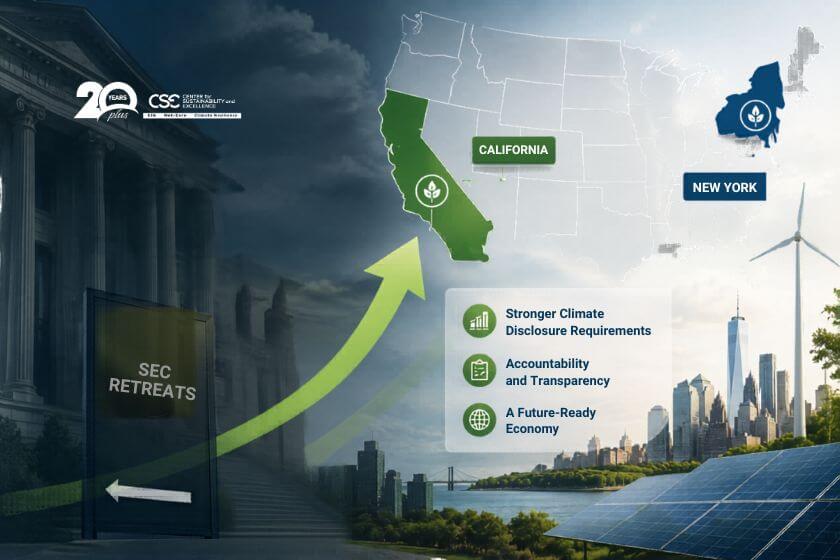
State climate disclosure is becoming one of the most important compliance issues for U.S. companies.
For several years, businesses watched the U.S. Securities and Exchange Commission’s climate disclosure rule as the main federal development. Now, the federal picture is uncertain. The SEC has moved away from the climate-related disclosure rules adopted in 2024, and companies are reassessing what this means for reporting, risk management, and compliance planning.
However, federal uncertainty does not mean climate disclosure is going away.
California continues to move forward with state-level climate reporting laws, including Senate Bill 253, the Climate Corporate Data Accountability Act. New York has also increased its focus on climate accountability, corporate emissions reporting, and climate-related costs. At the same time, investors, lenders, customers, insurers, and global regulators continue to ask companies for reliable climate data.
This creates a clear message for companies: the SEC may retreat, but climate disclosure expectations are still moving forward.
For many businesses, the risk is not only federal compliance. The bigger challenge is a fragmented reporting landscape where state laws, international standards, customer requirements, and investor expectations overlap.
Editor’s note: Climate disclosure requirements are legally sensitive and may change quickly. Companies should confirm current obligations with legal counsel and official regulatory sources before making compliance decisions.
The Shift From Federal Rules to State Climate Disclosure
The SEC’s climate rule was designed to create a federal reporting framework for public companies. If federal requirements are weakened, delayed, or rescinded, some companies may assume they can slow down their climate reporting work.
That assumption may be risky.
State climate disclosure laws can apply based on where a company does business, not only where it is headquartered. A company outside California may still fall within California requirements if it meets the revenue threshold and does business in the state. Similarly, companies with customers, suppliers, financing relationships, or operations in major markets may face pressure to provide climate data even without a direct federal mandate.
This is why climate disclosure is no longer just a sustainability issue. It is also a legal, financial, operational, and governance issue.
Companies need to understand where they operate, which laws may apply, what data they need, and how climate-related information connects to business risk.
California, New York, and the Emerging State-Level Landscape
California currently provides the clearest example of state climate disclosure in the United States. SB253 applies to large companies that do business in California and meet the law’s revenue threshold. It requires reporting of greenhouse gas emissions, including Scope 1, Scope 2, and Scope 3 emissions. This is significant because Scope 3 emissions often represent the largest and most difficult part of a company’s carbon footprint.
California has also advanced climate risk reporting through related legislation, including SB261. Together, these laws show that the state is not only focused on emissions data but also on how companies understand and manage climate-related financial risk.
New York is taking a different but related path. Its climate accountability efforts have included proposals focused on corporate emissions reporting and verified annual climate data. New York’s Climate Superfund law also shows how states may connect climate responsibility with adaptation costs, infrastructure impacts, and long-term public spending.
Companies should treat these developments as part of a broader trend. Even if one federal rule changes, climate-related disclosure may continue through state law, market pressure, contractual requirements, and international reporting standards.
Comparison of Key Climate Disclosure Developments
| Area | Main Focus | Who May Be Affected | Why It Matters |
|---|---|---|---|
| SEC climate disclosure rule | Climate-related disclosures for public companies | Public companies subject to SEC reporting | Federal rules may change, but companies still need to monitor investor and market expectations |
| California SB253 | Annual greenhouse gas emissions reporting | Large companies doing business in California that meet the revenue threshold | Requires Scope 1, Scope 2, and Scope 3 emissions reporting |
| California SB261 | Climate-related financial risk reporting | Large companies doing business in California that meet the revenue threshold | Connects climate risk with governance, strategy, and financial planning |
| New York climate accountability proposals | Corporate emissions reporting and accountability | Companies that may fall within future state requirements | Shows that other states may follow California’s lead |
| New York Climate Superfund law | Climate responsibility and adaptation costs | Large fossil fuel companies and other covered entities, depending on final application | Signals a broader state-level approach to climate-related financial responsibility |
| EU and global standards | Sustainability and climate disclosure | Companies with international operations, customers, investors, or supply chains | Global expectations may affect U.S. companies even without direct U.S. federal rules |
Before publishing, add official links to the SEC, California Air Resources Board, California legislative records, and New York State sources.
Why Early Preparation Creates a Business Advantage
Companies that prepare early for state climate disclosure can reduce compliance risk and improve decision-making.
First, early action gives teams more time to collect and test data. Climate disclosure depends on information from many parts of a business, including facilities, energy use, procurement, logistics, travel, finance, and suppliers. Waiting until final deadlines are close often leads to rushed estimates and weak documentation.
Second, better emissions data can support better business decisions. A company that understands its emissions profile can identify energy-saving opportunities, supplier risks, operational inefficiencies, and exposure to future regulation.
Third, climate reporting can protect trust. Investors, lenders, customers, employees, and business partners increasingly expect companies to explain how they manage climate risk. Even where disclosure is not legally required, poor data or vague claims can damage credibility.
Finally, early preparation supports market access. A company may not be based in California or New York, but it may sell into those markets, source from suppliers there, raise capital from investors who expect climate data, or serve customers with their own reporting obligations.
In other words, climate disclosure readiness can become a competitive advantage.
Practical Steps for Companies
1. Build a Regulatory Map
Start by identifying where your company operates, sells, hires, owns assets, has legal entities, or maintains major customer relationships. Then compare that footprint with state climate disclosure laws and emerging requirements.
This map should answer several basic questions:
| Question | Why It Matters |
|---|---|
| Do we do business in California? | California climate disclosure laws may apply to companies outside the state |
| What is our annual revenue? | State laws often apply based on revenue thresholds |
| Are we public or private? | Some rules apply beyond public companies |
| Do our customers require emissions data? | Contractual pressure can create reporting obligations even without direct regulation |
| Do we operate internationally? | EU and global standards may influence reporting expectations |
| Do we have reliable emissions data? | Weak data creates risk when assurance or verification is required |
This step should involve legal, finance, sustainability, and operations teams.
2. Create a Greenhouse Gas Emissions Inventory
A reliable emissions inventory is the foundation of climate disclosure.
Companies should start by organizing emissions into three categories:
Scope 1 emissions are direct emissions from sources the company owns or controls. These may include fuel burned in company facilities, vehicles, or equipment.
Scope 2 emissions are indirect emissions from purchased electricity, steam, heating, or cooling.
Scope 3 emissions are indirect emissions across the value chain. These may include purchased goods and services, supplier activity, logistics, business travel, employee commuting, product use, waste, investments, and end-of-life treatment of sold products.
Scope 3 is often the most complex category. Companies do not need to solve everything at once, but they should begin by identifying the most material categories and the highest-risk data gaps.
3. Prioritize Scope 3 Data
Scope 3 emissions can be difficult because much of the data sits outside the company. Suppliers, distributors, customers, and logistics partners may all affect the final calculation.
A practical Scope 3 approach should include:
| Priority | Action |
|---|---|
| Identify material categories | Focus first on the Scope 3 categories most relevant to the business |
| Segment suppliers | Start with high-spend, high-emission, or strategically important suppliers |
| Improve data quality over time | Move from broad estimates toward supplier-specific data where possible |
| Document assumptions | Keep clear records of methods, emission factors, and calculation choices |
| Connect procurement and sustainability | Make emissions data part of supplier engagement and purchasing decisions |
This process takes time. Starting early gives companies a better chance of producing consistent, credible, and auditable data.
4. Assign Internal Ownership
Climate disclosure cannot sit only with the sustainability team.
Good reporting requires cross-functional ownership. Finance teams understand controls and reporting discipline. Legal teams assess regulatory risk. Procurement teams manage supplier data. Operations teams understand facilities and energy use. Investor relations teams know what stakeholders expect. The board and senior leadership provide oversight.
Companies should create a clear governance structure that defines who owns each part of the process.
At minimum, this should include:
| Function | Role in Climate Disclosure |
|---|---|
| Sustainability | Emissions inventory, reporting frameworks, climate strategy |
| Finance | Controls, audit readiness, financial risk integration |
| Legal | Regulatory interpretation, disclosure risk, compliance review |
| Procurement | Supplier data, Scope 3 engagement, contract requirements |
| Operations | Energy data, facilities, transport, efficiency projects |
| IT/Data | Systems, data quality, access controls, documentation |
| Board/Senior leadership | Oversight, risk management, strategic direction |
This structure helps climate reporting become a managed business process rather than a last-minute reporting exercise.
5. Strengthen Data Controls and Documentation
Many companies begin climate reporting with spreadsheets. That may be acceptable in the early stages, but spreadsheets alone may not support assurance, verification, or regulatory review.
Companies should improve data quality by documenting:
- Data sources
- Calculation methods
- Emission factors
- Assumptions and estimates
- Internal review steps
- Version control
- Approval processes
- Evidence from suppliers or utility providers
The goal is not only to calculate emissions. The goal is to show how the company calculated them and why the results are reliable.
This is especially important if a law requires third-party assurance or verified reporting.
6. Connect Disclosure With Business Action
Climate disclosure should not be treated as a separate communications project. It should show how the company manages risk and improves performance.
Companies can connect reporting to practical action by using emissions data to support:
- Energy efficiency projects
- Renewable energy procurement
- Supplier engagement
- Logistics optimization
- Product redesign
- Climate risk assessments
- Capital planning
- Insurance discussions
- Board oversight
- Carbon reduction targets
This makes disclosure more useful for decision-makers and more credible for external stakeholders.
Common Mistakes to Avoid
- Waiting for Final Rules Before Starting
One of the biggest mistakes is waiting until every rule is final before doing any work. Climate data collection can take months or years to mature. Companies that wait may face rushed reporting, incomplete supplier data, and weak internal controls.
- Assuming the SEC Retreat Ends Climate Reporting
The SEC is only one part of the climate disclosure landscape. California, New York, the EU, investors, lenders, customers, and industry standards can all create reporting pressure.
- Treating Climate Disclosure as a Marketing Exercise
Climate disclosure is not only about reputation. It can involve legal risk, financial risk, operational risk, and assurance requirements. Companies should avoid vague claims that are not supported by data.
- Ignoring Scope 3 Until the Last Minute
Scope 3 data is often the hardest to collect. It depends on supplier cooperation, estimates, emission factors, and clear methodology. Companies should begin with the most material categories and improve data quality over time.
- Keeping Finance Out of the Process
Climate risk can affect costs, assets, insurance, supply chains, revenue, financing, and capital access. Finance teams should be involved early so climate disclosure aligns with broader business planning.
A Practical State Climate Disclosure Checklist
Companies can use the following checklist to begin preparing:
| Step | Action |
|---|---|
| 1 | Confirm where the company does business and which state laws may apply |
| 2 | Review revenue thresholds and applicability criteria |
| 3 | Identify current emissions data sources |
| 4 | Build or update Scope 1 and Scope 2 emissions calculations |
| 5 | Identify material Scope 3 categories |
| 6 | Engage priority suppliers for better data |
| 7 | Assign ownership across sustainability, finance, legal, procurement, and operations |
| 8 | Document methods, assumptions, and emission factors |
| 9 | Review whether assurance or verification may be required |
| 10 | Connect reporting with climate risk management and reduction plans |
This checklist should be reviewed regularly as state rules, deadlines, and guidance evolve.
Real-World Applications
A company with more than $1 billion in annual revenue may not be headquartered in California, but it could still need to assess California SB253 if it does business in the state. This means legal and finance teams should not assume location alone determines compliance exposure.
A manufacturer may need to collect Scope 3 data from key suppliers because purchased goods and logistics represent a large share of its emissions. In that case, procurement becomes central to climate disclosure readiness.
A retailer may need to understand emissions from stores, distribution centers, purchased electricity, transportation, and product supply chains. Better climate data can help identify energy savings and supply chain risks.
A professional services firm may have fewer direct emissions but still need to track purchased electricity, business travel, employee commuting, and supplier-related emissions.
These examples show why companies need a flexible reporting foundation. The strongest approach is not to build a separate process for every new rule. It is to create one reliable climate data system that can support multiple reporting needs.
FAQs
- What is state climate disclosure?
State climate disclosure refers to state-level rules that require companies to report climate-related information. This may include greenhouse gas emissions, climate-related financial risk, governance practices, or actions taken to manage climate risk.
California SB253 is one of the leading examples of state climate disclosure in the United States.
- Does state climate disclosure apply only to companies based in California or New York?
Not necessarily. Some state climate disclosure laws may apply to companies that do business in the state, even if they are headquartered elsewhere. Companies should review their operations, sales, revenue, legal entities, and customer relationships to assess possible exposure.
- What are Scope 1, Scope 2, and Scope 3 emissions?
Scope 1 emissions come directly from sources a company owns or controls, Scope 2 emissions come from purchased energy, and Scope 3 emissions come from the company’s value chain, including suppliers, logistics, business travel, product use, and other indirect activities.
- Is the SEC climate rule finished?
The federal climate disclosure landscape remains uncertain and should be checked against current SEC releases. Even if the SEC weakens or rescinds federal climate disclosure requirements, companies may still face state laws, investor expectations, customer requests, and global reporting standards.
- Why is Scope 3 reporting so difficult?
Scope 3 reporting is difficult because the data often comes from suppliers, customers, logistics providers, and other third parties. Companies may need to use estimates at first, then improve data quality over time through supplier engagement and better systems.
- Is climate reporting useful beyond compliance?
Yes. Climate reporting can help companies identify cost savings, supplier risks, energy efficiency opportunities, operational weaknesses, and exposure to future regulation. Strong reporting can also support investor confidence and customer trust.
- Is climate disclosure important for career growth?
Yes. Climate disclosure skills are increasingly valuable across sustainability, finance, legal, procurement, risk management, operations, and investor relations. Professionals who understand emissions data, reporting frameworks, assurance, and climate risk can support stronger business decisions.
Start Building State Climate Disclosure Readiness
State climate disclosure is becoming more important, not less.
Even if federal rules change, companies still face pressure from California, New York, investors, customers, lenders, insurers, and global standards. The best response is to build a reliable reporting foundation now.
That means mapping regulatory exposure, building emissions inventories, improving Scope 3 data, assigning internal ownership, documenting methods, and connecting disclosure with real business action.
Companies that prepare early will be better positioned to reduce compliance risk, improve data quality, protect stakeholder trust, and respond faster as state climate disclosure requirements evolve.
To strengthen your readiness, explore the USA Certified Sustainability Practitioner Program, Advanced Edition 2026, designed for professionals who want to build practical sustainability leadership skills in a changing regulatory landscape.
Through the Dual Certification Process, participants can further enhance their expertise by dedicating an additional 22 to 25 hours to one specialization course of their choice.
- specialization in carbon reduction and net zero,
- specialization in sustainable supply chain,
- specialization in sustainability ESG reporting,
- New specialization in IFRS S1 & S2 Sustainability Reporting Standards (SASB -TCFD),
- specialization in Certified Circular Economy Professional or
- specialization in Green Marketing.