 English
  Spanish
  French


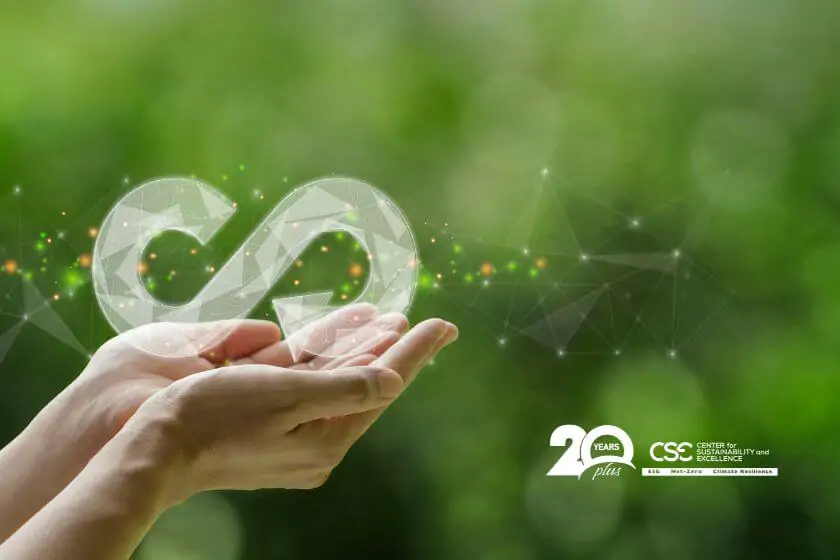


The circular economy has moved from an emerging sustainability concept to a business priority.
Organizations now face growing pressure to reduce waste, improve resource efficiency, strengthen supply chains, and create long-term value. At the same time, regulators, investors, customers, and employees expect companies to show measurable progress on sustainability, ESG, and responsible business transformation.
Recent European Environment Agency analysis shows why this shift matters. Circular economy actions can reduce climate impacts, biodiversity loss, air pollution, and dependency on imported raw materials. This makes circularity both an environmental solution and a strategic economic opportunity.
That is why circular economy principles and product circularity are becoming essential for sustainability professionals and business leaders.
To support this transition, the Center for Sustainability and Excellence (CSE) is hosting its Annual Sustainability Practitioner’s Event, Circular Economy in Action: Why Sustainability and Product Circularity Matter Now, on Thursday, June 25, 2026, from 10:00 AM to 11:30 AM CDT.
This online event will bring together sustainability practitioners, corporate executives, academics, and circular economy experts to share practical insights, real-world examples, and actionable strategies for embedding circularity into business practices.
Introduction to Circular Economy in Action and Why It Matters
The traditional “take-make-dispose” model is becoming increasingly unsustainable.
Resource scarcity, climate risks, waste generation, supply chain disruptions, and stakeholder expectations are forcing organizations to rethink how products are designed, produced, used, and recovered.
A circular economy aims to keep products, materials, and resources in use for as long as possible. It focuses on eliminating waste, extending product lifecycles, regenerating natural systems, and improving resource efficiency.
Product circularity applies these principles directly to product design and management. It encourages companies to create products that can be reused, repaired, refurbished, remanufactured, recycled, or reintegrated into future value chains.
This is especially important as circularity becomes part of policy and market expectations. In Europe, the proposed Circular Economy Act aims to strengthen markets for secondary raw materials, improve transparency, encourage durable and repairable products, and increase circular material use. These trends show that companies need to prepare for a future where circular design, traceability, repairability, and lifecycle responsibility become central to competitiveness.
The Circular Economy in Action event will explore how organizations can move from sustainability commitments to measurable business outcomes.
Benefits of Circular Economy and Product Circularity
Organizations that embrace circularity can unlock important business advantages.
Stronger Business Resilience
Circular business models can help companies reduce dependence on volatile raw material markets and improve supply chain stability. By keeping materials in use, companies can reduce exposure to resource scarcity and supply disruptions.
Greater Innovation
Circular thinking encourages product redesign, repair services, resale models, material recovery, sharing platforms, and new revenue opportunities. It also supports innovation across sectors such as packaging, electronics, textiles, construction, mobility, and ocean-based value chains.
Improved Sustainability Performance
Circularity supports waste reduction, carbon reduction, resource efficiency, and broader sustainability and ESG goals. It helps organizations connect environmental commitments with practical operational change.
Competitive Advantage
Customers, investors, regulators, and employees increasingly favor organizations that demonstrate responsible and sustainable business practices. Companies that act early can build stronger credibility and prepare for evolving expectations.
Long-Term Value Creation
Circular strategies help companies create economic value while addressing environmental and social challenges. For example, resale, refurbishment, and repair can turn used products into new business opportunities instead of waste.
This is why circularity is not only a sustainability initiative. It is becoming a boardroom-level business transformation topic.
Why Product Circularity Is Also a Market Opportunity
Product circularity is increasingly linked to consumer behavior and business model innovation.
Consumers are showing growing interest in refurbished electronics, resale platforms, secondhand apparel, and products with longer lifecycles. Research from UT San Antonio highlights how resale, rebates, and secondhand markets are reshaping the relationship between manufacturers, retailers, and consumers.
This matters because circularity must work economically. Manufacturers may worry that resale will reduce new product sales. However, the right pricing, rebate, and partnership models can create win-win outcomes. New products can remain attractive, while secondhand and refurbished products extend value and reduce waste.
For sustainability professionals, this creates an important lesson. Circular economy strategies must combine environmental purpose with sound business design. Companies need incentives, supplier collaboration, customer engagement, and fair value-sharing models.
The Blue Circular Economy: A Growing Frontier
Circular economy thinking also applies to ocean-based industries.
The blue circular economy focuses on applying circular principles to marine and coastal value chains. This includes better waste collection, segregation, recycling, reuse, innovation, and investment in ocean-related sectors.
Blue circular economy discussions increasingly focus on how coastal enterprises, MSMEs, investors, and policymakers can scale solutions that reduce marine waste, support sustainable growth, and strengthen resilience. This is highly relevant for companies connected to packaging, shipping, seafood, tourism, logistics, ports, textiles, plastics, and coastal infrastructure.
For business leaders, the message is clear. Circularity is not limited to factories or product teams. It extends across supply chains, ecosystems, communities, and natural resources.
Practical Steps to Implement Circular Economy Strategies
The event is designed to help professionals understand how to move from circular economy strategy to action.
Participants will explore how to:
Integrate circular economy principles into corporate strategy.
Build circular product design frameworks.
Engage suppliers, employees, and stakeholders.
Measure circularity performance.
Explore reuse, repair, resale, and refurbishment models.
Use circularity to support supply chain resilience.
Overcome implementation barriers.
Communicate circular economy initiatives effectively.
Align circularity with ESG, sustainable supply chains, and business transformation goals.
Industry experts will also share lessons from real-world projects and practical examples that professionals can apply within their own organizations.
Common Mistakes Organizations Make When Adopting Circularity
Many organizations struggle to implement circular economy strategies because they treat circularity as a separate sustainability project instead of a core business model.
Common mistakes include focusing only on recycling, ignoring product lifecycle redesign, failing to engage suppliers, lacking measurable circularity metrics, and underestimating the importance of employee education and stakeholder communication.
Another common mistake is failing to consider market incentives. Circular products and services need demand, pricing strategies, operational support, and credible communication. Without these elements, circularity can remain a good idea without business traction.
The event will address these challenges and provide practical guidance for avoiding them.
Real-World Applications and Expert Insights
A key strength of the event is the opportunity to hear directly from professionals working across sustainability, ESG, reporting, circular economy, communication, and business transformation.
Featured speakers include:
Nikos Avlonas, Founder and President of CSE, will discuss circular economy, ESG, and business transformation.
David Marshall, Vice President of Sustainability Governance & Reporting at Domtar, will share practical strategies and real-world examples for embedding circularity into business practices.
Edward A. Johnson, Sustainability Manager at Energy Vault, will provide perspectives on how circular economy principles can support innovation and long-term sustainability value.
Michael Sheridan, Associate Professor at SUNY New Paltz and CSE Sustainability & Circular Economy Consultant, will discuss circular economy and product circularity in practice.
Rosalinda Sanquiche, CSE Advisor, Trainer, and Communications Expert, will share case studies in circular economy communication and stakeholder engagement.
John Gremer, CSE Associate, Chicago Office, will coordinate a practical panel discussion on circular economy in practice.
Together, these speakers will help attendees understand why circular economy matters now, how circularity can be implemented, and how organizations can communicate progress with credibility.
Event Agenda
The online event will take place on Thursday, June 25, 2026, from 10:00 AM to 11:30 AM CDT.
Sessions will include opening remarks, expert presentations, panel discussions, Q&A sessions, and insights into trends and new certification programs. Topics include circular economy and product circularity, circular economy in practice, circular economy communication, ESG, and business transformation.
Attendees will also learn about new certification programs and receive information about a special discount available to event participants.
About CSE
The Center for Sustainability and Excellence has more than 20 years of impact in sustainability education and consulting. Through its Sustainability Academy, CSE has helped empower sustainability leaders globally.
CSE connects more than 11,000 sustainability and ESG practitioners globally and focuses on six key pillars: ESG strategy, net-zero transition, climate resilience, circular economy, sustainable value creation, and leadership for impact.
Frequently Asked Questions About Circular Economy
What is circular economy in simple terms?
A circular economy is an economic model designed to reduce waste and keep products, materials, and resources in use for as long as possible through reuse, repair, refurbishment, remanufacturing, and recycling.
Why is product circularity important?
Product circularity helps organizations design products with longer lifecycles, lower waste, better resource efficiency, and improved sustainability performance.
Is circular economy knowledge useful for career growth?
Yes. Circular economy knowledge is increasingly valuable for professionals working in sustainability, ESG, supply chains, product innovation, corporate responsibility, and business transformation.
Who should attend Circular Economy in Action?
This event is ideal for sustainability professionals, ESG leaders, corporate executives, consultants, supply chain professionals, product teams, communications experts, and anyone involved in sustainable business transformation.
Register for Circular Economy in Action
The transition toward a circular economy is accelerating across industries.
Organizations that understand and implement circularity effectively will be better positioned to innovate, strengthen resilience, meet stakeholder expectations, and create long-term sustainable value.
Join CSE’s Circular Economy in Action: Why Sustainability and Product Circularity Matter Now on Thursday, June 25, 2026, and gain practical insights from experienced sustainability professionals.
Secure your spot and become part of the conversation shaping a circular and sustainable future.
Please note that this is an exclusive event available only to certified Certified Sustainability (ESG-P) Practitioners within CSE’s global practitioner network.