
 English
  Spanish
  French


Sustainability Training ROI: Budget or Advantage?

Sustainability training ROI has become a real business question for U.S. companies. Training budgets face pressure. Managers want proof. HR teams need a clear reason to approve participation. Yet sustainability now affects risk, reporting, supply chains, client expectations, reputation, and long-term planning. So, the question is not only, “Can we afford this training?” A better […]
Product Circularity in Sustainability Strategy
Product Circularity: Missing Link in Sustainability Strategy Product circularity is becoming one of the most important parts of sustainability strategy. Yet many companies still treat it as a technical issue, a recycling target, or a waste management project. That view is too narrow. Product circularity starts much earlier. It begins with design. It asks how […]
How to Build a Sustainability Plan During Geopolitical Turbulence
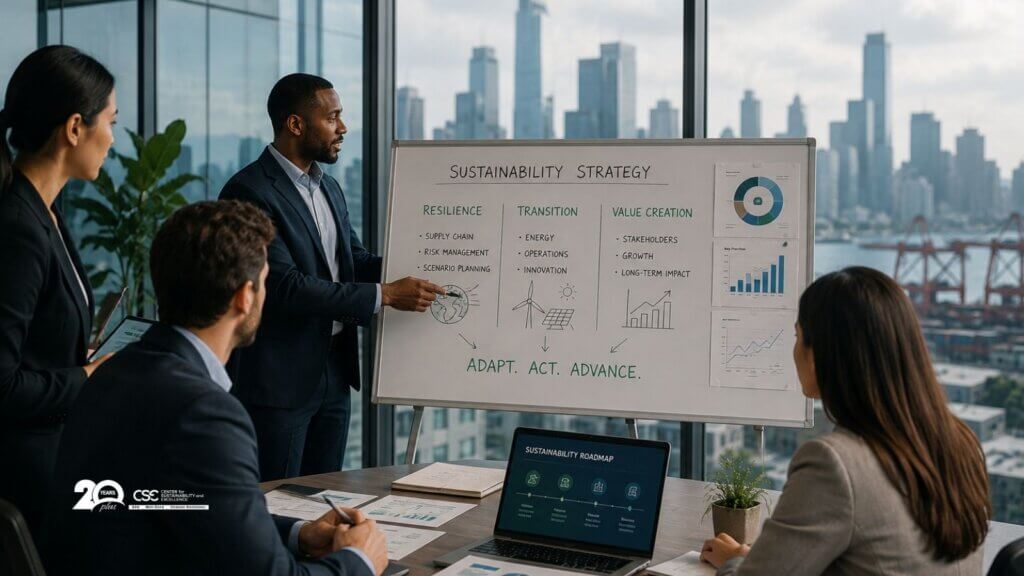
Why Sustainability Planning Matters More During Uncertainty Geopolitical instability is now a direct business risk for many U.S. companies. Trade restrictions, regional conflicts, shipping disruptions, energy market volatility, climate-related events, and changing sustainability regulations can affect costs, suppliers, operations, and customer expectations. For business leaders, the question is no longer whether sustainability matters. The real […]
Why Sustainability ESG Consultants Must Master Climate Resilience

Climate change has become a business issue, not only an environmental concern. Companies now face heatwaves, floods, droughts, supply chain disruptions, rising insurance costs, infrastructure risks, and growing investor pressure. As a result, sustainability consultants must move beyond traditional ESG reporting and help organizations prepare for climate impacts that directly affect business performance. Organizations increasingly […]
How Sustainability Due Diligence Affects U.S. Companies

Sustainability due diligence is becoming a serious business issue for U.S. companies. At first, it may look like a European legal topic. However, its impact can reach American firms through customers, suppliers, contracts, audits, and global value chains. The key question is not only, “Does this rule directly apply to us?” A better question is, […]
Canada Sustainability Training: What CSE’s First 2026 Cohort Reveals About ESG Skills Demand

The first Canada cohort of the Certified Sustainability ESG Practitioner Program, Advanced Edition 2026 was completed in April, bringing together senior professionals from business, academia, consulting, environmental services, communications, and industrial sectors. The group included participants from TELUS, Scotts Miracle-Gro, Ya YA Foods Corp., The Beer Store, McGill University, the Commission for Environmental Cooperation, Toronto […]
New Laws Are Exposing Weak Sustainability Teams

Weak sustainability teams are being exposed by new U.S. laws, climate reporting pressure, and rising expectations from customers, investors, and regulators. For many companies, the challenge is no longer whether sustainability matters. The real challenge is whether their teams have the skills to manage reporting, carbon data, circular economy, supply chains, and business risk. For […]
State Clean Energy Policy: Why U.S. Teams Need Practical Skills Now

Clean Energy Rules Are Outpacing Companies State clean energy policy is becoming one of the biggest pressure points for U.S. companies. For years, many businesses treated sustainability as a national or global issue. Today, that approach is no longer enough. Companies now need to understand state rules, local energy targets, utility requirements, procurement options, emissions […]
Is Weak Sustainability Data Your Next Risk?

Why sustainability data risk matters now Sustainability data risk is becoming a board-level business issue for U.S. companies. It affects finance, operations, procurement, suppliers, technology decisions, and public trust. The challenge is no longer only whether a company publishes a sustainability report. The real question is whether the company can prove the numbers, methods, assumptions, […]
Is New York Coming for Your Carbon Data?

New York emissions data business risk is becoming a real concern for companies that operate, sell, transport, power, or invest in the state. For years, many organizations treated greenhouse gas emissions data as a sustainability metric. Now, New York is turning that data into a business signal. The reason is clear. New York’s Climate Leadership […]