 English
  Spanish
  French


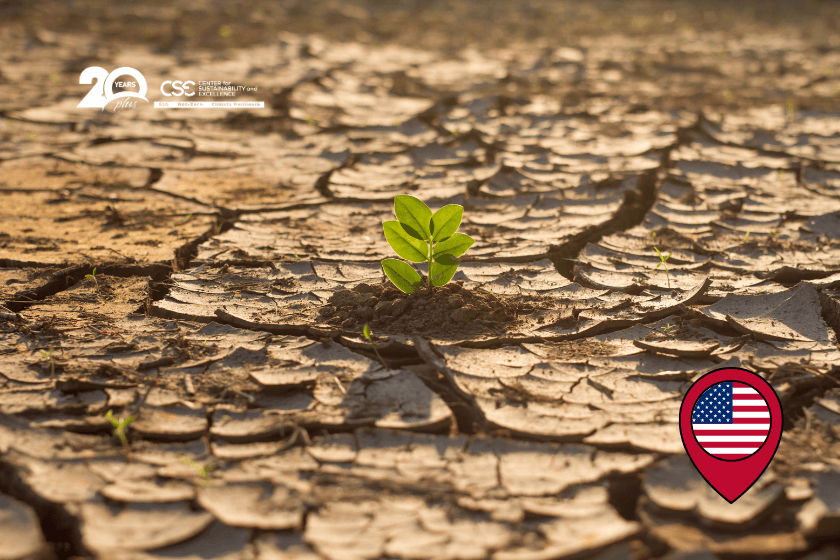


The climate crisis in the United States is no longer a future concern. It is already reshaping how companies operate, invest, and compete.
From supply chain disruptions to rising insurance costs, climate-related risks are becoming core business challenges. As a result, companies are moving faster on sustainability, not because of pressure alone, but because it increasingly makes business sense.
According to Trellis, this year marks a shift from bold climate commitments to execution-focused strategies. Companies now prioritize measurable results, operational integration, and financial impact over public pledges.
For U.S. professionals, this shift creates both urgency and opportunity.
Climate risk is now a business risk
The growing intensity of climate events is forcing companies to rethink risk management.
A recent climate report highlighted critically low snowpack levels across parts of the U.S., increasing concerns about drought, water scarcity, and wildfire exposure. These risks directly affect industries such as agriculture, energy, logistics, and real estate.
At the same time, policy uncertainty complicates long-term planning. Analysis from Brookings shows that regulatory rollbacks and fragmentation across federal and state levels are creating a more unpredictable investment environment.
This combination creates what many executives now describe as a “double pressure” environment:
- Physical risk is increasing
- Regulatory clarity is decreasing
As a result, companies cannot afford to wait. They must act despite uncertainty.
Media and stakeholder pressure are accelerating change
Public expectations around sustainability are evolving rapidly.
Media coverage of extreme weather, corporate accountability, and environmental performance is shaping how stakeholders evaluate companies. At the same time, clients, investors, and employees are asking more detailed questions about risk exposure, emissions, and long-term resilience.
However, as Trellis reports, companies are no longer responding with broad commitments alone. Instead, they are making strategic trade-offs, deciding where to invest, where to scale back, and how to deliver realistic progress.
Another Trellis analysis highlights that 2026 is a critical year for evolving methodologies, including emissions tracking and target-setting frameworks. This means expectations are becoming more technical and harder to meet without internal expertise.
Companies are shifting from ambition to execution
One of the most important changes in the U.S. market is the shift from ambition to execution.
According to McKinsey, sustainability is increasingly driven by four business priorities: competitiveness, resilience, cost efficiency, and long-term value creation.
This shift is visible across sectors:
- Energy and utilities are investing in resilience and diversification
- Retail and manufacturing are focusing on supplier transparency and cost control
- Financial institutions are integrating climate risk into lending and investment decisions
For example, large U.S. retailers are now requiring suppliers to provide emissions data and operational transparency. This is not only about environmental responsibility. It is about risk visibility and procurement efficiency.
In practice, leading companies are embedding sustainability into:
- Capital allocation decisions
- Supply chain management
- Product development
- Risk and compliance systems
Sustainability is no longer a standalone initiative. It is becoming part of core business infrastructure.
A new skills gap is emerging
As companies accelerate action, a clear skills gap is emerging.
Organizations need professionals who can move beyond strategy and into execution. This includes the ability to:
- Identify material climate risks
- Interpret evolving regulations and frameworks
- Manage emissions data across value chains
- Build internal business cases for sustainability investments
- Communicate effectively with stakeholders
This shift can be described as the “Execution Gap” in sustainability.
Many organizations understand what needs to be done. Fewer know how to implement it effectively.
That gap is where professionals can create the most value.
Why training is becoming essential
In this environment, structured training is no longer optional. It is becoming a competitive advantage.
Professionals who understand both the strategic and operational sides of sustainability are better positioned to support decision-making, reduce risk, and drive measurable outcomes.
The Certified Sustainability Practitioner Program – Advanced Edition is designed to address this exact need. It focuses on practical skills such as sustainability strategy development, reporting, and performance measurement within a U.S. business context.
Importantly, programs like this should not be viewed as theoretical learning. Their value lies in helping professionals translate market trends into real-world action.
Participants typically work on:
- Real case scenarios from global companies
- Practical frameworks for implementation
- Tools for aligning sustainability with business performance
This type of applied learning is increasingly what employers are looking for.
From pressure to competitive advantage
The U.S. climate crisis is creating a new business reality.
Companies face increasing physical risks, evolving stakeholder expectations, and ongoing policy uncertainty. At the same time, they must remain competitive and financially strong.
Those that succeed will not be the ones with the most ambitious promises. They will be the ones that can execute effectively.
For professionals, this creates a clear direction. The ability to turn sustainability pressure into structured, measurable action is becoming one of the most valuable skills in the market.
Building that capability now is not just a career move. It is a strategic advantage.