 English
  Spanish
  French


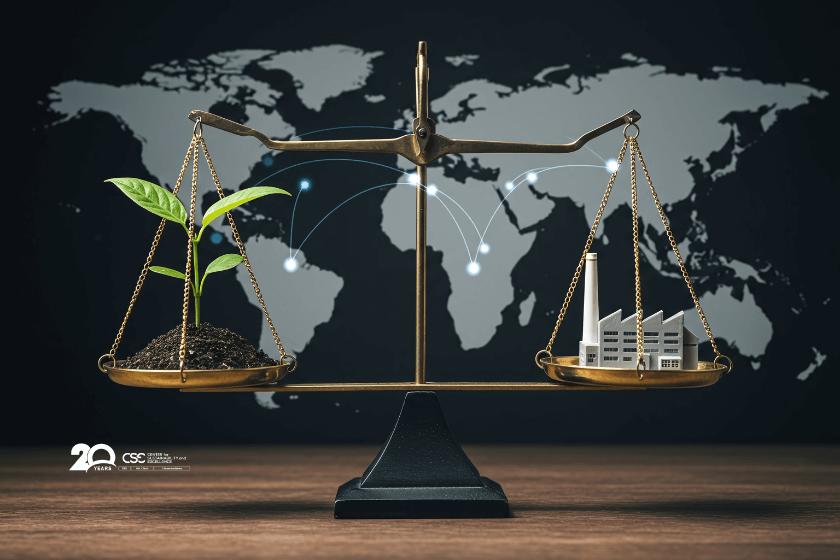


For decades, sustainability was viewed as a cost or a constraint on growth. In 2026, that perception no longer reflects reality. Across the United States, companies are demonstrating that sustainability strengthens long-term economic performance, improves resilience, and builds competitive advantage.
Rather than slowing growth, sustainability is now a core driver of efficiency, innovation, and trust. The organizations that lead in this space do not treat sustainability as a side initiative. They integrate it into strategy, operations, and leadership decision-making.
Why Sustainability Supports Long-Term Economic Performance
Reducing Business Risk in a Volatile Economy
Economic uncertainty, climate impacts, and supply chain disruptions increasingly affect corporate performance. Climate-related risks can amplify financial instability by disrupting operations, infrastructure, and markets.
Research from Harvard Business School shows that companies investing early in sustainability practices experience lower long-term volatility and stronger financial outcomes compared to peers that delay action.
For U.S. companies, sustainability is therefore not about reputation alone. It is a risk management strategy that protects long-term value.
Improving Operational Efficiency and Cost Control
One of the most immediate economic benefits of sustainability is operational efficiency. Energy efficiency improvements can reduce industrial energy consumption by up to 30%, delivering measurable cost savings while increasing productivity.
In parallel, analysis from McKinsey Global Institute confirms that organizations that optimize resource use and reduce waste often outperform competitors on margins over time.
These findings explain why sustainability initiatives increasingly sit within operations, procurement, and finance teams, not only sustainability functions.
Building Brand Trust and Market Confidence
Trust has become a key economic asset. The Edelman Trust Barometer shows that trust directly influences customer loyalty, employee retention, and long-term brand value, especially during periods of disruption.
In addition, PwC research indicates that U.S. consumers are more willing to support companies that demonstrate credible environmental and social responsibility, even when prices increase.
This growing expectation means sustainability performance now affects revenue, talent attraction, and investor confidence.
U.S. Companies Turning Sustainability into Growth
Net Zero and Climate Leadership
Microsoft has committed to becoming carbon negative by 2030 and removing its historical emissions by 2050. Its strategy includes internal carbon pricing and long-term investments in carbon removal technologies.
The World Economic Forum highlights internal carbon pricing as a best practice for embedding climate considerations into business decisions.
Microsoft’s targets are also aligned with the Science Based Targets initiative (SBTi), a globally recognized authority that supports science-based climate action across industries.
Circular Economy in Practice
The circular economy is increasingly viewed as a growth opportunity rather than a constraint. The Ellen MacArthur Foundation, a leading authority on circular economy frameworks, identifies companies such as Apple as contributors to scalable circular design through recycled materials and closed-loop manufacturing.
By reducing dependence on virgin materials, circular strategies help companies manage resource risk while stabilizing long-term costs.
Sustainable Supply Chains
Supply chains remain one of the largest sources of environmental and social impact. According to the U.S. Environmental Protection Agency, upstream and downstream supply chain activities often account for the majority of a company’s footprint.
U.S. companies such as Unilever USA respond by working closely with suppliers to improve traceability, reduce emissions, and strengthen long-term supply security.
The Leadership Execution Gap
Despite growing evidence, many U.S. companies struggle to turn sustainability commitments into measurable outcomes. MIT Sloan Management Review highlights a persistent execution gap driven by limited internal capabilities, unclear priorities, and weak governance structures.
This challenge is not about ambition. It is about leadership readiness.
Turning Strategy into Action in 2026
The CSE Certified Sustainability Practitioner Program – Advanced Edition (USA 2026) is designed for professionals who need to move beyond concepts and frameworks.
The program equips leaders to:
-
Align sustainability with core business strategy
-
Integrate climate, circular economy, and supply chain priorities into operations
-
Define KPIs, governance structures, and accountability
-
Translate sustainability goals into business-ready initiatives
A key outcome of the program is the development of a practical two-year sustainability action plan. Participants leave with a customized roadmap they can immediately apply within their organization.
This approach reflects guidance from institutions such as the OECD and UN Global Compact, which emphasize long-term planning, leadership ownership, and integration into business strategy as critical success factors.
Sustainability and Growth Are Now Linked
The data is clear. Sustainability strengthens economic performance when embedded into leadership decisions, operations, and long-term planning.
For U.S. companies entering 2026, the real risk lies in inaction. Those who invest in sustainability capability today will lead in resilience, efficiency, and trust tomorrow.
Advanced education and structured planning are no longer optional. They are essential tools for building sustainable growth in the U.S. market.