 English
  Spanish
  French




Why SB-253 Matters Now
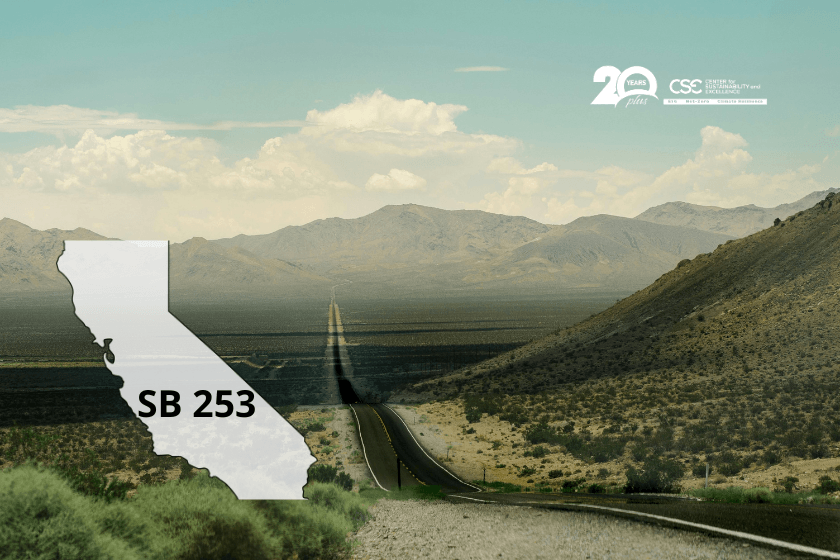
California SB-253 introduces mandatory greenhouse gas emissions disclosure for large companies starting in 2026. Companies must report Scope 1 and Scope 2 emissions first, followed by Scope 3.
This marks a structural shift. Until now, most U.S. companies approached sustainability reporting as voluntary or investor-driven. SB-253 turns it into a legal requirement.
Importantly, the law applies to companies doing business in California, not just those headquartered there. According to the California Air Resources Board (CARB), which will oversee implementation, this expands the rule to thousands of companies across sectors.
Why It Impacts the Entire U.S.
Although SB-253 is a state law, its impact is national.
Large organizations do not maintain separate reporting systems per state. Instead, they standardize processes across operations. As a result, California’s requirements become the baseline.
A recent analysis by Harvard Law School on sustainability disclosure in a fragmented U.S. regulatory landscape highlights that, in the absence of federal alignment, state-level rules are increasingly shaping corporate reporting practices.
In practical terms, SB-253 is already influencing how companies across the U.S. measure, manage, and disclose emissions.
The Domino Effect Across States
California has historically set the pace for environmental regulation, and others follow.
New York has introduced similar proposals for mandatory emissions disclosure. Meanwhile, states like Washington and Colorado continue to expand climate-related requirements.
Research from the Brookings Institution shows that state-level leadership is accelerating climate policy adoption across the U.S., especially when federal progress slows.
This creates a clear trajectory. Companies should not prepare for one regulation. They should prepare for a system of expanding state-level requirements.
Regulatory Fragmentation Is Increasing Pressure
The U.S. still lacks a unified federal framework for sustainability disclosure.
Instead, companies face a patchwork of requirements from states, investors, and global standards. This creates operational complexity.
Organizations must align multiple data systems, reporting timelines, and assurance processes.
According to McKinsey, companies that embed sustainability into core operations improve resilience and reduce long-term costs. Those that treat it as a reporting exercise fall behind.
Therefore, the challenge is not just compliance. It is integration.
Business Risk Is No Longer Theoretical
Sustainability reporting now carries direct business risk.
Incomplete or inaccurate data can lead to compliance exposure. At the same time, public disclosure increases scrutiny from investors, clients, and regulators.
Coverage from ESG Dive shows that companies face growing pressure to provide consistent, decision-useful emissions data, especially as disclosure expectations evolve.
This marks a shift from narrative reporting to data accountability.
As a result, sustainability reporting is now a core business function tied to risk, performance, and reputation.
The Biggest Challenge: Scope 3 Emissions
Scope 3 emissions are the most complex element of SB-253.
According to the Greenhouse Gas Protocol, Scope 3 often represents more than 70 percent of total emissions in many sectors. It includes 15 categories, from purchased goods and services to transportation, product use, and end-of-life treatment.
Unlike Scope 1 and 2, Scope 3 requires value chain engagement.
A practical example comes from large retailers and manufacturers. Many struggle to collect supplier emissions data because smaller vendors lack reporting systems. This leads to inconsistent data, estimation gaps, and delayed disclosures.
Trellis reports that supplier engagement and data quality remain the biggest barriers to Scope 3 implementation across industries.
Without structured processes and tools, Scope 3 reporting becomes unreliable and difficult to audit.
The Skills Gap Is Slowing Progress
Despite regulatory pressure, many organizations lack the expertise to respond effectively.
Teams often understand the requirement but not the execution. Common gaps include:
- Applying GHG Protocol methodologies
- Mapping Scope 3 categories across the value chain
- Building internal data systems
- Preparing for third-party assurance
In practice, this leads to fragmented data, delayed reporting, and increased risk.
From direct experience working with U.S. organizations, the challenge is rarely awareness. It is capability.
From Compliance to Strategy
Leading companies are taking a different approach.
They treat SB-253 as a catalyst, not a constraint. Instead of focusing only on compliance, they integrate sustainability data into decision-making.
For example, detailed emissions tracking often reveals inefficiencies in logistics, sourcing, or energy use. Addressing these issues reduces both emissions and operational costs.
McKinsey’s research confirms that companies integrating sustainability into strategy outperform peers in long-term value creation.
This is where regulation becomes opportunity.
Why Capability Building Matters Now
SB-253 is not just a reporting requirement. It is a capability test.
Organizations need professionals who can:
- Translate regulation into implementation
- Apply carbon accounting frameworks
- Engage suppliers and collect data
- Connect emissions data to business decisions
Without these capabilities, compliance becomes reactive and expensive.
With them, it becomes strategic.
Build These Skills Through U.S. Training
For professionals navigating SB-253 and similar regulations, structured, practical training is becoming essential.
The Certified Sustainability Practitioner Program – Advanced Edition is designed specifically for the U.S. market and focuses on real-world implementation.
Participants develop skills in:
- Carbon accounting aligned with GHG Protocol
- Scope 1, 2, and 3 emissions management
- Sustainability reporting and disclosure requirements
- Supply chain engagement and data collection
Unlike purely theoretical courses, the program emphasizes application. It helps professionals translate regulatory requirements into systems, processes, and measurable outcomes inside their organizations.
You can explore the program here.
Final Thought
California SB-253 is not an isolated regulation. It is a signal of where the U.S. market is heading.
More disclosure, more scrutiny and accountability.
Companies that invest early in systems and skills will gain control, reduce risk, and create value.
Those that delay will face complexity without preparation.
In this environment, the real differentiator is not awareness. It is capability.